Tuesday, December 12, 2017

The "New" Guinea Sound


From Independence in 1958 until the death of dictator Sekou Touré in 1984, there was only one record company in Guinea, the legendary Syliphone label. Not only that, all professional musicians in the country performed under the aegis of the Parti Démocratique de Guinée, the only legal political party. They were employed by the state, which provided musical instruments and venues. This could make for some uncomfortable situations, such as when when trumpet player Balla Onivogui fell afoul of some government bureaucrats in 1970 and was deposed as leader of his own group, Balla et ses Balladins, in favor of his sideman Pivi Moriba. "Pivi et ses Balladins" recorded one album before the status quo ante was restored when Sekou Touré himself intervened.

This all sounds like a very stifling state of affairs, but in fact during this period Guinea produced some of the most vital and original music to come out of the African continent. The official cultural  policy was Authenticité, which rejected European influences and sought a return to African roots for inspiration (similar policies were in place in Mali, Tanzania and Congo [Zaïre] for a time). It's all documented in an excellent 2-CD compilation on the Sterns label, Authenticité: The Syliphone Years (STCD 3025-26, 2007), ably curated by Dr. Graeme Counsel, which samples the 83 LPs and 77 45s released by Syliphone.

Several years ago Dr. Counsel finished digitizing Syliphone's archives in their entirety, including many, many recordings that were never pressed on vinyl. You can listen to all of them on the British Library's website. At the completion of this massive project Guinea's Ministry of Culture held a celebration, featuring among others the legendary Amazones de Guineé:


This Golden Age of Guinean music came to an end in 1984 when Sekou Touré died and Syliphone was scrapped. The many national and regional musical groups sponsored by the Ministry of Culture were cast to the vagaries of the free market. Some survived and still perform to this day. Many foundered. Taking the place of Syliphone were a number of independent labels, dealing now in cassettes rather than vinyl (I would assume cassettes also have gone by the wayside since, but who knows?).

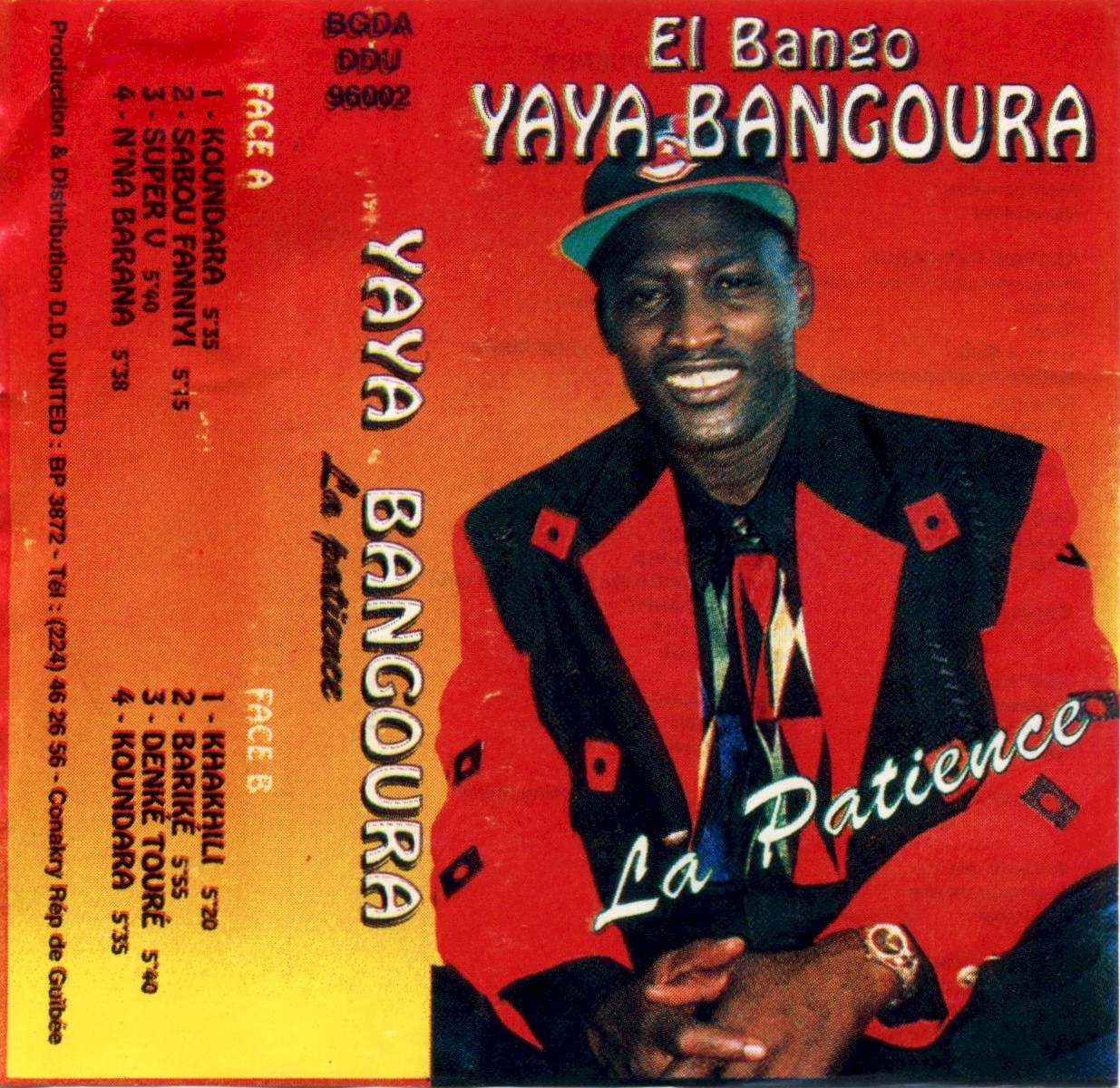
Guinean music, freed from political constraints, has tended more toward the slick sound that typifies modern African popular music, often utilizing synthesizers but still making use of traditional instruments like the kora and balafon. It is often recorded outside Guinea, for instance in Abidjan's JBZ Studios, as was today's selection, Yaya Bangoura's La Patience (D.D. United 96002, 1996).

Bangoura typifies the "new" breed of Guinean musicians (that is, "new" as of 1996 - I confess to not having heard much recent music from that country, although I'm sure there's plenty). He was born in 1957 and became a teacher in 1982. However, he'd always had an interest in music and was a featured singer on Syli Authentique's 1976 album Dans l'Arène (Syliphone SLP 57). La Patience was his first solo recording effort, followed in short order by Kalanyi, Koule Yèlè and several tours which would take him to Europe, the United States and Canada.

Crippling back problems have forced "El Bangou" to perform in a chair for some time. I read, however, that he recently arrived in the US for specialized medical care. Here's hoping that he will continue to entertain us for many more years!

Yaya Bangoura - Koundara

Yaya Bangoura - Sabou Fanniyi

Yaya Bangoura - Super V

Yaya Bangoura - N'na Barana

Yaya Bangoura - Khakhili

Yaya Bangoura - Bariké

Yaya Bangoura - Denké Touré

Yaya Bangoura - Koundara

Download La Patience as a zipped file here.

Wednesday, December 6, 2017

Urban Azmariwotch


The azmari is the Ethiopian equivalent of the West African griot - a troubadour, a truth-teller and "court jester" all in one, disdained and beloved at the same time. The essential release Éthiopiques 2: Techawet!: Urban Azmaris of the '90s (Buda Musique 82952-2, 1997) traces the development of a new urban form of the azmari's art to the the fall of the putatively "Marxist-Leninist" Dergue regime in 1991. Restricted by a curfew for the previous 18 years, residents of Addis Ababa took to nightlife with a vengeance, giving rise to many new azmarebets, or cabarets devoted to this musical form.

The usual azmari ensemble is composed of one or two vocalists, players of the krar (Ethiopian lyre), masinqo (one-stringed violin), percussion and perhaps accordeon. As today's selection, the cassette Democracy Mebtesh (Negarit Music Shop, ca. 1992) illustrates, this combination can be supplemented by organ or synthesiser, electric bass and drum machine (somewhat to the detriment of the music, in my opinion). 

The title, Democracy Mebtesh ("Your Democratic Right"), clearly alludes to the atmosphere that prevailed in Ethiopia in the early '90s after the fall of the Dergue and the rise of a new government led by the Ethiopian People's Revolutionary Democratic Front. My friend Andreas Wetter writes, "...I think it is meant in a rather ironic way. I remember having heard it used by people from time to time. The media was full of words about democracy but everyone knew that there was no real democracy. People usually felt a subtle oppression and didn't believe in the offiocial discourse, because there were imprisonments, often arbitrary, and even killings."

Our featured artists, Betsat Seyoum Abhra and Abbebe Fekade, exemplify the new urban azmariwotch. Betsat, born in 1965, does not come from a musical family but found her calling in 1985 performing in various establishments in Addis before opening her own azmarebet in 1990. Abbebe, born in 1970, by contrast comes from a musical heritage in the province of Gondar, where his father was an azmari.Performing together in Betsat's establishment, they are naturally simpatico!


Bati is one of the four major kiñits, modes or scales of Ethiopian music, the others being Tezeta, Ambassel and Anchihoye. For many years I thought "Bati" was an actual song. There are many versions extant and I featured one in a previous post. Andreas Wetter, though, tells me that no two versions have exactly the same words. The versions I've heard have usually been male and female duets, and even though I don't understand the lyrics, have always struck me as being flirtatious in nature. Andreas tells me the version here is particularly scandalous. Francis Falceto's liner notes for Betsat's and Abbebe's CD Urban Azmaris of Ethiopia (Long Distance 122166, 1995) translate the lyrics as follows:


As Falceto further explains, the words are more than what they seem. The underlined lyrics above are the literal meaning whereas the boldface are the actual meaning. The Abyssinica Dictionary explains, "Wax and Gold is the formula used by the Ethiopians to symbolize their favorite form of verse. It is a form build of two semantic layers. The apparent, figurative meaning of the words is called 'Wax'; their hidden actual significance is the 'Gold'. The term Wax and Gold is derived from the work of the goldsmith, who constructs a clay mold around a from created in wax and then, draining the wax, pours the molten gold into that form...." During the time of Haile Selassie and later under the Dergue such verbal subterfuge was a vital form of social protest.


Tezeta (or "Tizita") is often described as "Ethiopian Blues." The word means "memory" or "nostalgia," and like Bati above, it is one of the four major kiñits, or modes, of Ethiopian music. No two versions of Tezeta, even if literally called "Tezeta," will ever be the same. Falceto, in the liner notes of Éthiopiques 10: Tezeta: Ethiopian Blues & Ballads (Buda Musique 82222-2, 2002), writes,"...Singing one's sadness isn't as paradoxical as it may seem. There has to be a way to get through life's cruel twists of fate, and from the world's often comes the inspiration to overcome alll manners of adversity, public or private. Might as well do it in a song. If the Afro-American blues is the best-known means of expression combining music with wallowing in misery, there are many musical cultures throughout the world that have formulated in their own way this odd mixture of brightness and gloom, heavy-handedness and lightness of heart..."


"Enneggänaññallän" = "We Will Meet." 


Ambassel is the name of a district in Wollo Province and is also one of the four kiñits of Ethiopian music. Wikipedia describes it as the mode used for songs with historical themes.


"Ende Näh" = "How Are You?"

Betsat Seyoum & Abbebe Fekade - Ende Näh

"Lomi Nahe (She) Waye" = "You are a Lime" (a term of affection).


Download Democracy Mebtesh as a zipped file here. Many thanks to Andreas Wetter, who, as always, has provided much useful information for this post. The liner notes of Éthiopiques 2, Éthiopiques 10 and Urban Azmaris of Ethiopia were also quite helpful. If you really want to dig into the details of Ethiopian musical theory (something that's above my head), you might like to read this article by Timothy Johnson, who discusses the four major kiñits of Ethiopian music - Bati, Tezeta, Ambassel and Anchihoye. This article by Ezra Abate is also quite detailed.

Thursday, November 30, 2017

Conspiration


Les Officiers of African Music were a "super-group" formed in the 1980s by Congolese musicians (mainly from the Brazzaville side of the river) in Paris, notably Tchico Tchicaya, Passi-Jo, Ballou Canta and Nianzi Gaulard, "L'Amiral Cheri-Gau," the star of today's offering, Conspiration (Savas SA 30.0048).

There's not much to say about this one except it's a primo example of mid-'80s Congo rumba at its best. Enjoy!


L'Amiral Cheri-Gau & Les Officiers of African Music - Ce Combat de la Vie

L'Amiral Cheri-Gau & Les Officiers of African Music - Mth Amour

L'Amiral Cheri-Gau & Les Officiers of African Music - Tungu

L'Amiral Cheri-Gau & Les Officiers of African Music - La Musique est une Science

Download Conspiration as a zipped file here.