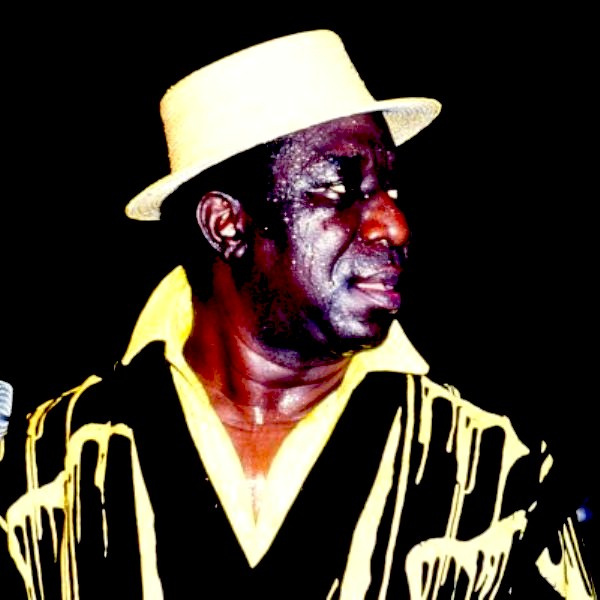
Today's post covers some old ground - classic orchestras from the stable of wunderkind Kiamwuangana Mateta, aka "Verckys," the musician and producer who blew up the Congo music scene back in the 1970s. A lot of this music has been posted in other venues, in fact a couple songs were featured here previously at Likembe. Still, I thought it would be useful to post Orchestres Kamale et Kiam (Vévé-Rogers All Stars VOZ 1003, 1982), as it gives an insight into the sort of Congolese sounds that Nigerians were listening to in the '70s and '80s. This LP was licensed from Verckys' label Vévé and pressed in Nigeria by Onitsha-based Rogers All Stars.
Side One of the LP features Orchestre Kiam, Side Two Orchestre Kamale. As was often the case at the time, at least for Nigerian releases of Congo music, most of these tracks are not complete, featuring only one side of the 45 versions. If you're interested, I've provided a link at the end of this post so you can download the complete versions.
My friend Matt Lavoie, formerly of the Voice of America, currently proprietor of the essential Wallahi le Zein! blog and Orchestre Kiam fanatic, has done the monumental work of compiling an oral history of the band. Do yourself a favor by going to his site, downloading and reading it and also downloading an almost-complete collection of their recordings. In Matt's telling, the musicians who became Kiam were "poached" by Verckys in 1973 from Papa Noel's Orchestre Bamboula when he brought them into the studio for a recording session! He christened the group after his own first name, and under his supervision they recorded a series of hits that made them a sensation in Kinshasa and throughout Africa.
Success, and Verckys's stifling sponsorship, brought dissension, and in 1975 a group of band members decamped to form Orchestre Baya-Baya, named after one of the group's early hits. With a new lineup, and with most of the defectors returning to the band after a while, Kiam acheived even greater heights, releasing in 1976 "Kamiki," their biggest hit ever, and a pan-African smash. By 1983 Orchestre Kiam had been dissolved, but alumni have played important roles in the Congo music scene to this day.
Orchestre Les Kamale is perhaps better known internationally thanks to the success of its leader Nyboma Mwan'dido. Nyboma was a singer with the Vévé group Orchestre Lipua-Lipua in 1975 when he split off to form Orchestre Les Kamale. This group divided in turn in 1978, a number of musicians leaving to form Orchestre Fuka Fuka and Nyboma reorganizing the remnant. Nyboma then broke with Verckys and set off on a journey across Africa and eventually to Paris, in the meantime recording the classic LP Double Double, which received international distribution. He's well-known both as a solo artist and as a member of Les Quatre Etoiles, the Congolese super-group.
Download OrchestresKamale et Kiam as a zipped file here. Click here to download complete versions of "Baya Baya," "Moni Afinda," "Ayi-Djo" and "Masua."
He was born in 1946 in Curral Velho on the island of Boa Vista. At the time Cape Verde, along with its sister countries Guinea-Bissau, Angola, Mozambique and São Tomé & Principe, were under the heel of Portuguese colonialism, and over the years armed resistance movements grew in opposition. Cape Verdean men over the age of 16 faced conscription to fight in these wars, so at the age of 13 Lima emigrated illegrally to Ivory Coast, where he took up typography. Moving on to Senegal, and then to Paris in 1969, he joined the Partido Africano da Independência da Guiné e Cabo Verde (PAIGC), a liberation movement devoted to the independence of Cape Verde and Guinea-Bissau, and began his career as a musician. The lyrics of Lima's songs in this period are marked by his devotion to the liberation of Cape Verde and African people, for instance "Cabral 1924-1973," dedicated to the memory of Amilcar Cabral, the assassinated founder of the PAIGC.
The liberation movements in Portugal's African colonies were successful to such a degree that they brought about the collapse of the Portuguese government itself, the Carnation Revolution of April 25, 1974, and independence for the African countries. Abel Lima returned to Cape Verde in 1974 to participate in its renaissance, and here recorded "Corre Riba, Corre Baxo," a stinging denunciation of the exploitation of African exiles in Europe. Unfortunately, family and economic necessities forced him to return to France.
It was during Lima's second French sojourn that he hosted a radio program, "Prends l'Afrique et Tire-Toi," and recorded today's offering, a 1983 LP by the same name (Radio Rivage AL 07). The backup band, Voz di Povo, draws on the ample supply of African musicians in Paris, including Congo's Maïka Munan, Ballou Canta and others. The result is a unique blend of Cape Verdean sounds and soukous. Delightful!
Over the years Abel Lima made a living in the printing industry in France while recording a number of albums as an avocation. After retiring in 2003 he returned home to Curral Velho, where he passed away in October 2016.
Just about everyone in the United States who started collecting African music in the 1970s and '80s is familiar with the productions of Brooklyn's African Record Centre, with its labels Makossa, Star Musique and others. Back in those days it was pretty much the only source in the US for authentic African music, by which I mean the sort of stuff that's listened to in Africa itself. The ARC licensed many recordings by Fela Ransome-Kuti (later Fela Anikulapo-Kuti), then only known to a small but devoted coterie. It released a raft of funky Ghanaian guitar-highlife records, recordings by Franco and other "Zaïrean" artists, 12" benga records produced by Kenya's indomitable P.O. Kanindo, and an amazing series by the US-based Sierra Leonean group Muyei Power, some of which have been gathered into a retrospective by London's Soundway Records.
These recordings would make their way through obscure distribution channels to record stores throughout the land, where perplexed clerks would stash them in the "International" bin along with records by Nana Mouskouri and Heino. "World Music™" had yet to be born!
By 1983 I had already been a fan of Fela's for a while, King Sunny Adé had made a splash, and in 1981 and '82 Mango Records had released two compilations of African music, Sound d'Afrique and Sound d'Afrique II: Soukous, both of which were revelations but especially the second, which showcased the music of the Democratic Republic of Congo, then called Zaïre. So, during a trip to New York City I had to make a pilgrimage to 1194 Nostrand Ave. in Brooklyn, this Mecca of African sounds.
I have to say the store was everything I'd hoped for, crammed to the gills with not only ARC's own productions but even more mysterious imports actually pressed in Africa! I wasn't exactly flush with cash at the time - I could only afford five LPs. I got a couple of Sunny Adé Nigerian pressings, and a French reissue of Fela's Coffin for Head of State. What would the fourth and fifth ones be? I liked the Zaïrean music I'd heard - could the clerk make a recommendation? It turned out Makossa had just released a number of recordings from that country, including the one the clerk handed over - Kele Bibi: Rochereau Vol. 8 (Disco Stock Makossa DM 5001, 1982), by an artist I'd never heard of - "Seigneur Tabu Ley."
I'll admit I looked at this record with some skepticism. Who was this middle-aged, rather paunchy fellow in a cheesy Elvis-style white jumpsuit and cape? But when the clerk put the record on the turntable I was sold! I got that one and a second record, Mpeve Ya Longo: Rochereau Vol. 7 (Disco Stock Makossa DM 5000, 1982), this one featuring Tabu Ley and a female singer, M'Bilia Bel:
According to Wikipedia, Pascal-Emmanuel Sinamoyi Tabu was born November 13, 1937 or 1940 in Bagata, in what was then the Belgian Congo. He came by his nickname "Rochereau" after correctly naming the French general Pierre Philippe Denfert-Rochereau in a quiz at school. In 1956 he joined African Jazz, the musical congregation of Joseph Athanase Tshamala Kabasele, or Le Grand Kallé, considered the father of modern Congolese music, and notched a number of hits with the group before leaving with Nicolas Kasanda wa Mikalay (known as Docteur Nico) in 1963 to form African Fiesta. This group split in turn in 1965, Rochereau forming African Fiesta National, renamed Afrisa International in 1970. Around this time he also took on the stage name "Tabu Ley" as part of President Mobutu Sese-Seko's Authenticité campaign.
During the '70s Afrisa International vied with Franco's TPOK Jazz and other groups to popularize Congolese music around the world, making it the most widespread and popular style across Africa. During this period Afrisa performed at the legendary Zaïre '74 concert, during FESTAC '77 in Lagos, and at the Olympia Theater in Paris.
It was Rochereau's lovely voice that made him a star, instantly recognizable on such classic tunes as "Afrika Mokili Mobimba" and many others, but it was his stage show and musical innovations that kept him on top for many years. Elvis, of course, was an inspiration, but so were James Brown and other American R&B stars. He even did a cover of the Beatles classic "Let it Be"
M'Bilia Bel (born Marie-Claire M'Bilia M'boyo in Kinshasa in 1959) got started as a singer and dancer with Abeti Masikini. Here she was spotted by Tabu Ley and invited to join his female backup group, the Rocherettes.She performed with them for a few years before making Mpeve Ya Longo with Ley,her recording debut. She was an immediate hit and soon cut a solo album, Eswi Yo Wapi (Genidia GEN 102, 1983), with more recordings, solo and with Tabu Ley, to follow. The pair were soon married, with Bel as the junior wife in Rochereau's polygamous marriage.
The two albums showcased here, Mpeve Ya Longo and Kele Bibi, come at an interesting inflection point in the careers of the two artists. The following year, 1983, would see the release of several recordings on Rochereau's Genidia label that catapulted the pair to international fame, with more to follow over the next few years. A compilation on the Shanachie label, Rochereau (43017, 1984) introduced them to US audiences. A few years ago Sterns Music released The Voice of Lightness Vol. 2 by Tabu Ley (STCD 3056-57, 2010) and Bel Canto by M'Bilia Bel (STCD 3037-38, 2007), which showcase the best music of the Genidia years.
The sound of Mpeve Ya Longo and Kele Bibi is subtly different from the Genidia recordings. I don't know if it's because of different recording engineers or what, but the mixes here are looser-sounding, less polished and push the vocals to the forefront while making way for some really inspired instrumental jams. Truly infectious!
After several years and one child together, the personal and professional partnership of Tabu Ley and M'Bilia Bel came to an acrimonius end in 1987, allegedly over disrespect shown by Bel to Tabu Ley's senior wife, Mimi Ley. Whatever the reason, Bel's career on her own, after a promising start with 1988's Phènomené(Mbilia Production MCB 001), has declined over the years, although she continues to record and tour.
Following Bel's departure, Rochereau hooked up with two new female singers, Faya Tess and her sister Beyou Ciel, and continued to record and tour internationally. After the fall of Presidnet Mobutu Sese-Seko in 1997 he took a cabinet position in the new government of Joseph Kabila and followed that up with several other positions over the years. He passed away on November 30, 2013 in Belgium and was buried in Kinshasa after an official mourning ceremony.
Download Kele Bibi as a zipped file here. I have Vols. 5 and 6 of this series also, and I might post them in the future.While researching this post I came across this rare video, which reunites Rochereau with his old partner, Docteur Nico. I suspect this was recorded in the early '80s, shortly before Nico's death, but he's in stellar form! Turns out this was uploaded by Stefan Werdekker of the excellent WorldService blog. Thaks, Stefan!