Saturday, May 4, 2019

Kinshasa Acoustic: Ali & Tam's avec l'Orchestre Malo


Ali and Tam's together with Orchestre Malo wrap up our retrospective look at three interesting Congolese LP's released in the mid '80s by the Swiss label Plainisphare. Their contribution is Malo (Plainisphare ZONE Z-5, 1986), and it's arguably the most interesting and creative of them.

Aly Sow Baidy and Tamisimbi Mpungu were professors at the Institut National des Arts du Zaïre in Kinshasa and founded Orchestre Malo "...to revalue and to disseminate this authentic musical culture in the spirit of a broad openness to current movements of music." Toward this end they combined traditional Congolese instruments with modern ones "to give birth to new sounds while respecting traditional drives." In a review of the three Plainispare releases in Volume 6, issue 4 of The Beat from 1987, Elizabeth Sobo wrote:

...From the Switzerland-based Plainisphare label comes three novelty albums, all recorded in Kinshasa, Zaire, between July 1984 and October 1985, and none of which bears much resemblance to the well-known Kinshasa sound.  
Ironically, the first of these is titled Kinshasa, by Kawende et ses Copains. This production is not consistently great, but it does contain two selections that deserve praise. "Ekusulu" is gentle, guitar-dominated folk music, made special by a youthful-voiced female singer who delivers the Lingala lyrics in a manner quite unlike her classy, professional counterparts in Kinshasa, but who projects an innocence that makes her one solo appearance on this lp truly memorable. "Eh Ya Ele" is reminiscent of some recent material from the Zairean group, Somo Somo, differing from the standard Kinshasa sound both in language - it is done only partly in Lingala by a male lead singer - and in its generous use of percussions. The nine tracks on this album offer a variety of music not found on many other collections (though most have an emphasis on drumming and folk guitar in common) and a mix of languages from south-central and eastern Africa.  
While the Kawende disk at least presents a glimpse of some uncommon but authentic Central African music, Ali and Tam's Orchestre Malo on their self-titled lp can make no such claim. The group is apparently named for its two principals: Aly Sow Baidy (whose name strongly suggests a West African origin) and Tamisimbi Mpungu. The languages heard on the album are no help in categorizing this effort, and the music's rhythms, instruments and vocals are an odd combination that gives no hint of a dominant regional influence. Two tracks, "Tcheko" (you can hear a few words in both Lingala and Swahili here) and "Anita," include some nice horn playing. And the vocal on "Sougmad" is definitely intriguing — in fact quite likeable —but with a sound that is more like Khartoum than Kinshasa. "Tshikona," an instrumental cut, is a low point, a senseless and unsatisfying Fela imitation. This record has little to offer except its originality and even that runs thin at times... 
...If these recordings suggest a trend towards the promotion of music from places we seldom hear, it is a welcome change indeed. But they also demonstrate some of  the pitfalls of "mixed" music, which often ends up representing no particular region or style...
I must say I disagree with this assessment! Ms. Sobo's writings in the The Beat were often informative but just as often infused with an intolerance toward any sort of African music that didn't fit her dogmatic conception of what "African Music" was supposed to sound like. Heaven forbid that Congolese and West African musicians might want to record together, or make music that doesn't represent any "particular region or style!" In my opinion this disc by Orchestre Malo succeeds admirably. In the years since 1986, Congolese music, at least the stuff we've heard, has become hopelessly formulaic. One wishes that the example set by this disc had been taken to heart and emulated more.


Download Malo as a zipped file here


Monday, April 29, 2019

Kinshasa Acoustic: Orchestre Sim-Sim International


Here is the second of three "unorthodox" Congolese albums released by the Swiss label Plainisphare in the mid-'80s. Nsimba Vuvu was a former associate of Manu Dibango and assembled Orchestre Sim-Sim International from members of a number of bands then extant in Kinshasa. Apparently their only recording, Nasiwedi (Plainisphare ZONE Z-4, 1986) continues the casual ambiance of the first album in this series, Kinshasa!, by Kawende et ses Copains (Plainisphare ZONE Z-1, 1984), which I posted a few days ago. Apart from one electric guitar, Nasiwedi is also acoustic and refreshingly casual in its approach, almost like a recorded jam session.

Researching this blog I often have occasion to consult my collection of back issues of The Beat, an indespensible magazine that was published in the US from the early '80s to the early 2000s. Volume 6, Number 4 from 1987 contains a rather dismissive review of the Plainsphare series by Elizabeth Sobo, who did admit to enjoying Orchestre Sim-Sim's album:

By far the best of the three Plainisphare contributions is the one by Orchestre Sim-Sim. Its opening selection, "Nasiwedi," combines Congolese guitars reminiscent of the Le Peuple productions of years past, highlife-style horns, sharp percussion, a fascinating, catchy beat and two rather ordinary (but adequate) male voices. Perhaps the best track and the one closest to contemporary Kinshasa music is "Sekele," a captivating dance number sung in Lingala. "Kokiko," another welcome addition to the album, is slower, with an East African flavor and alternating male and female lead vocals. 
Sobo seems to have a rather dogmatic view of how "real" African music is supposed to sound. As I noted about Kinshasa!, these three recordings, while different from the Congolese music we usually hear, are undoubtedly authentic and probably representative of a whole stratum of sounds that is seldom recorded. In a few days I'll post the final entry in the Plainisphare series, an album by Ali & Tam's and Orchestre Malo.

Orchestre Sim-Sim International - Nasiwedi

Orchestre Sim-Sim International - Eh! Ya Ya


Download Nasiwedi as a zipped file here.


Wednesday, April 24, 2019

Kinshasa Acoustic: Kawende et ses Copains


Kinshasa!, by Kawende et ses Copains (Plainisphare ZONE Z1, 1984), was the first of three LPs released in the mid-'80s by the Swiss recold label Plainisphaire. These pressings, all recorded in Kinshasa, in the country then known as Zaïre and today as the Democratic Republic of Congo, are notable for sounding not really very much like what is generally perceived as Congolese music at all! This is no reflection on their authenticy, though. I'm sure they're quite typical of the sort of genuinely popular Congolese music that is never recorded, or recorded but not considered "commercially viable" outside of the country.

The sound here is loose and unpolished, probably recorded in one take. The musicians are not slick but all the more affecting for that. I don't know who Kawende and his group are as the liner notes give little information. I'm sure you'll enjoy this!

Kawende et ses Copains - Kinshasa!

Kawende et ses Copains - Tshura

Kawende et ses Copains - Sawande

Kawende et ses Copains - Ekulusu

Kawende et ses Copains - Mtoto Mpotevou

Kawende et ses Copains - Kabibi

Kawende et ses Copains - Eh Ya Ele

Kawende et ses Copains - Tshingoma

Kawende et ses Copains - Sosange Mosi

Download Kinshasa! as a zipped file here. I will soon be posting the other two albums in this series, Nasiwedi (Plainisphare ZONE Z-4, 1985), by Orchestre Sim-Sim International, and Malo (Plainisphaire ZONE Z-5, 1986), by Ali & Tam's avec l'Orchestre Malo.


Wednesday, April 10, 2019

Reggae Senegal


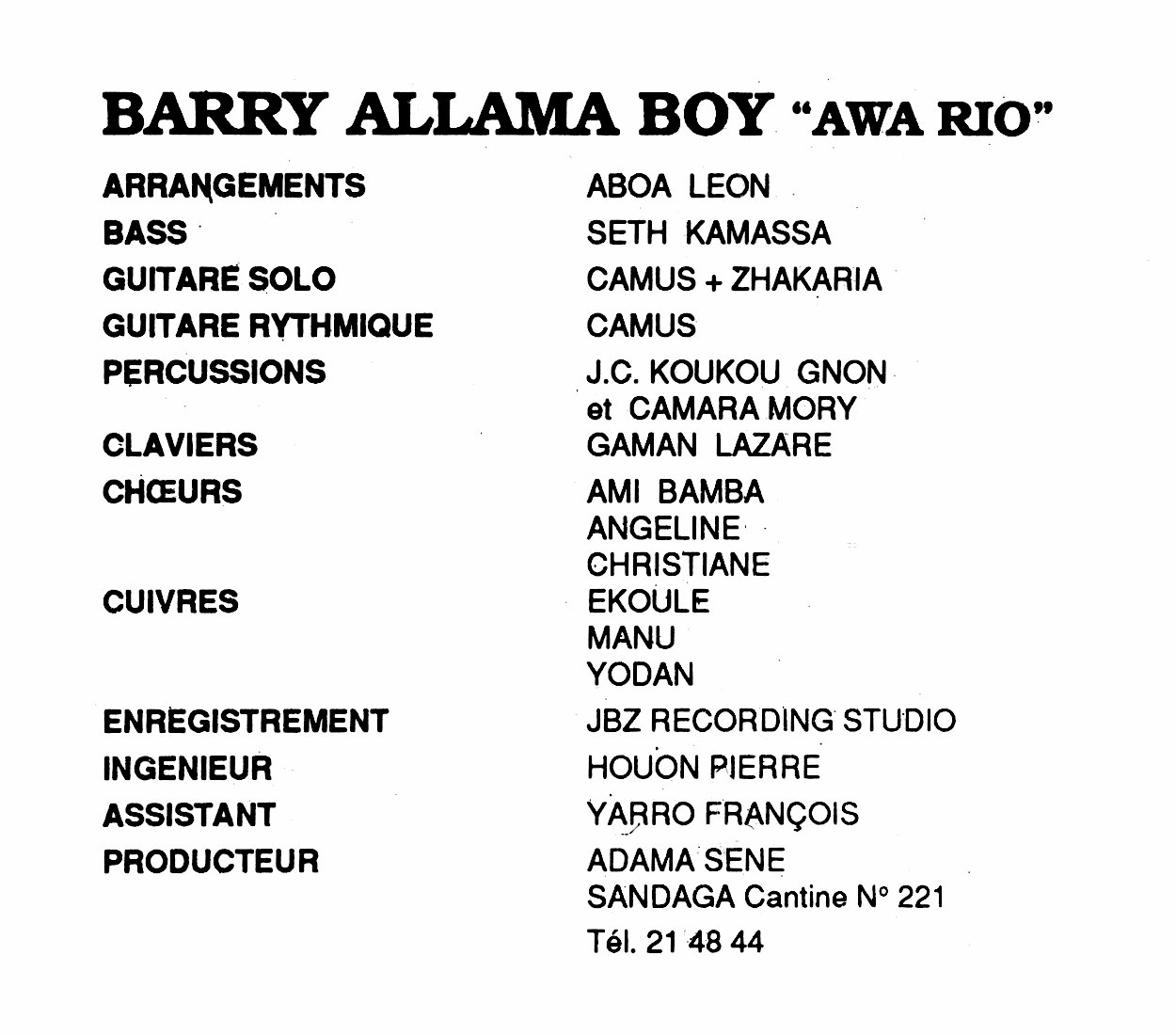
Barry Allama Boy is a musician about whom I've been able to find nothing, and I mean NOTHING, on the internet or anywhere else. This cassette, Medina Larabi, was recorded in Ivory Coast, but I believe he is from Senegal, probably from the southern Casamance region. I like this indigenous Senegalese take on reggae music and I hope you will too!


Download Medina Larabi as a zipped file here.


Friday, April 5, 2019

Music For Ramadan


I just realized that Ramadan this year begins the evening of May 5 and ends the evening of June 4. It's a little early, but I thought it would be nice if we could listen to some music from Nigeria that is intended for this auspicious occasion.

There are two terms for Yoruba Islamic music used to arouse the faithful during Ramadan: Ajísáàri and wéré. Ajísáàri refers either to the style of music or the person who performs it. Ajísáàri is usually performed solo and wéré by ensembles. Ajísáàri and wéré are performed by men. A related genre, wákà, is performed by women. These popular Islamic styles are percursors of secular fújì music, which is quite popular in Yorubaland. Christopher Alan Waterman discusses this music in his essential study Jùjú: A Social History and Ethnography of an African Popular Musc (University of Chicago Press, 1990):

Extensive Islamic conversion led to the development of musical genres performed during Muslim holidays (e.g., Ramadan, Id El-Fitr) and ceremonies marking the return of pilgrims from Mecca (àláji, m.; àlájà, f.). One of the earliest of these genres was wákà, sung by women and accompanied by beaten sélí or péréṣéké, pounded tin discs with metal rings attached. Another popular genre, wéré or ajísáàri, was performed by groups of young men during the Ramadan fast to wake the faithful for their early meal. Both of these genres incorporated aspects of Islamic cantillation — nasalized, tense vocal quality, melismatic text settings, microtonal melodic embellishments, and Qur'anic texts — into performances guided by Yoruba musical values and techniques. Wákà and wéré were associated with the high status of Islam in traditional Lagos and the continued vitality of economic networks linking the Yoruba to Muslim societies in the northern hinterland. 
Today's musical offereing, Itan Anabi Muhammad (Leader Records LRCLS 61, 1987), is one of a number recorded by the youth group of the Ansar-Ud-Deen Society of Lagos. The Society itself is a fraternal and educational association founded by Yoruba Muslim notables in 1923. It was a response to the ascendence of Christian elites and had a reformist conception of Islam which sought to reconcile it with modern ideas.

Ansar-Ud-Deen Youth (Lagos Branch) - Yatarikan Li Solathi / Itan Anabi Muhammad

Ansar-Ud-Deen Youth (Lagos Branch) - Alhamdu Lil'Lahi

Ansar-Ud-Deen Youth (Lagos Branch) - Latarkanana Ilal Ahwah / Eje Ka Ronu Eyin Araiye / Bi Al Ouyaoma Ba De

Download Itan Anabi Muhammad as a zipped file here.


Monday, March 25, 2019

Back to the Village


It's time for another deep dive into the world of "Igbo Blues"- real village music from southeastern Nigeria!

I know nothing about Goddy and Achinkwa and their musical group. This LP, Anya Ukwu Adiro Nma (Nigerphone NXLP 014, 1989), though, is one of the best examples of this genre I've heard, displaying the full panoply of traditional bells and percussion - ogene, onye ekwe, igba and the like. Enjoy!

Goddy na Achinkwa Musical Group - Uchicha Melu Ife Ebolu Oke

Goddy na Achinkwa Musical Group - Ezigbo Omume Akaka

Goddy na Achinkwa Musical Group - Anya Ukwu Adiro Nma

Goddy na Achinkwa Musical Group - Lagos Special (Ego Igwe)

Download Anya Ukwu Adiro Nma as a zipped file here.


Wednesday, March 20, 2019

A Purloined Master Tape


Back in the early days of online file-sharing, the 1973 album Destruction (Orbitone OT 005) by the Nigerian group the Nkengas achieved legendary status, traded far and wide and included on numerous funky mixes. When an official reissue came out in 2013 (Secret Stash Records SSR-CD-293), fans could satisfy their cravings legally.

The Nkengas released one other LP, Nkengas in London (Orbitone OT 006, 1973), which I feature here. It's apparent even from a casual listening that this is a radically different recording than Destruction. Every song save one ("Asa Mpete Special") features the vocals of the great highlife superstar Chief Stephen Osita Osadebe.

What's going on here? The story, as best I can piece it together, involves a number of sessions in London in the early '70s, which produced some of Osadebe's most beloved recordings. At some point in the process members of Osadebe's backup band, the Nigeria Sound Makers, led by Victor Okoroego, defected, taking a master tape with them and marketing it as Nkengas in London. Destruction, on the other hand, is pretty much pure Okoroego save for one track, "London Special," with Osadebe on lead vocals.

After Nkengas in London the group changed its name to the Ikenga Super Stars of Africa, who were to achieve fame and fortune with a number of chart-topping hits. "Asa Mpete Special" on Nkengas in London features Pele Asampete on vocals. This is a slightly reworked version of  the Osadebe hit "Ezi Ogelidi" from the album Egbunam (Philips 6361024, 1972). Asampete later left the Ikengas and did another version of this tune, "Ezi O Goli," on his solo LP (Rogers All Stars RASLPS 043). Pop/highlife star Chris Mba did still another remake in the early 1990s.


Download Nkengas in London as a zipped file here.


Friday, March 15, 2019

Ebenezer Obey Sings For The People


Singing For The People (Obey WAPS 578, 1980) continues the explorations in jùjú-funk that Ebenezer Obey started with Eyi Yato (Decca WAPS 508, 1980), posted a few days ago in this space. There's nothing much more I can say except if you liked that one, you'll like this one. Enjoy!

Chief Commander Ebenezer Obey & his Inter-Reformers Band - Singing For the People / Je K'Ajo Mi Jashi Rere

Chief Commander Ebenezer Obey & his Inter-Reformers Band - Alfa Omega / O Se Baba

Chief Commander Ebenezer Obey & his Inter-Reformers Band - Eiye To Ma Ba Kowe Ke / Mori Sisi Kan / Eje A Mo / Nike Oluwole

Download Singing For The People as a zipped file here.


Sunday, March 10, 2019

"This is Something Different"


I was under the impression that Nigeria's jùjú legend Ebenezer Obey had retired from the music scene some years ago, but it turns out I was wrong! Benson Idonije in The Guardian of Lagos reports:

...Only recently on September 15, 2018, he almost pulled down the roof of the now popular 10 Degrees Events Center in Ikeja, Lagos. What with excitement almost reaching bursting point and applause rising to a deafening crescendo? He was performing at a high society wedding with the Executive Governor of Ogun state, His Excellency, Ibikunle Amosun as chair person. Obey went down memory lane to remind the audience about the past. He also came up with new songs most of which he created on the spur of the moment with the spontaneity of a prolific composer. At 76, his voice is still as strong as ever, moving with considerable ease in all the vocal registers –high, middle and low. 
Not many musicians are capable of playing music that has the enduring allure of Obey’s juju music: full of melodic inventiveness and driven by messages of peace, hope and goodwill, this trait has characterized Obey’s music from the very beginning of his career. I remember the impact he made in the 80s while I was still in broadcasting and was organizing a scientifically credible hit parade that had Popular Music and Nigerian Social Music as its extent of enquiry. Most of his releases topped the charts and remained there almost forever where some others hit the number one slot and crashed out in no time – an indication that these were just instant hits and disposable flukes that could not stand the test of time. Ebenezer Obey is the pioneer of modern juju music. His melodies and messages have a way of naturally growing on the people....
Speaking of Memory Lane, I think it's an auspicious time to post here one of the Chief Commander's recordings from the '80s, one that truly stands out for its wild inventiveness and funky chops. Which is saying something, the '80s jùjú scene being at the pinnacle of creativity and influence. The liner notes of Eyi Yato (Oti Brothers OTI 508, released in Nigeria as Decca WAPS 508, 1980) say it well:

...The tracks on this album are a complete departure from the mainstream of juju format, although Obey's style and grace of delivery is very distinct. Obey has attempted and achieved in this album a very high level of sophistication through his powerful guitar fireworks, beautiful lyrics and masterly instrumentation. As Obey himself said on one of the tracks on the album, "THIS IS SOMETHING DIFFERENT" or to put it properly in Yoruba language "EYI YATO." 
Enjoy! And if you like this one, be sure to check out Likembe's Ebenezer Obey archive. Next up I will be posting another classic Obey LP from the '80s, Singing for the People (Obey WAPS 578, 1983)

Chief Commander Ebenezer Obey & his Inter-Reformers Band - Ere Wa Di Oloyin Momo / Kosi Eni Ti O Mo Ojo Ola / Tepa Mose / Chief George Oyedele


Download Eyi Yato as a zipped file here.


Tuesday, March 5, 2019

I Love Bikutsi, but I Love Makossa Too!


The two major musical styles of Cameroun are bikutsi, centered around the capital city Yaoundé, and makossa, from the coastal metropolis Douala. I've really been getting into bikutsi lately, and posting some of it here, but I love me some makossa also!

Makossa arose in the early 20th century with the intersection of the rhythms of the local Douala people and foreign sounds brought in by merchant marines, and mutated into a modern dance style by the '60s. Notable for its distinctive beat, the sound got a big boost with the success of Camerounian musician Manu Dibango and his 1972 international hit, "Soul Makossa," which ironically, wasn't makossa at all! Jean-Victor Nkolo writes in the 1994 book World Music: The Rough Guide:

...the fact remains that, with the exception of his bold venture (this is not his territory, say purists) into bikutsi with ' 'Mouvement Ewondo" on his Seventies album, and maybe another exception, "Idiba" (composed by Francis Bebey), Dibango, who is primarily a jazz musician, has never been the cup of tea of Cameroon's DJs, nor popular in the drinking parlours, nor has he cut any kind of figure in the  clubs or on the dance floors.  
Cameroonians generally consider "Soul Makossa" to be a hybrid - funky music with lashings of brass and a relatively strange rhythm that's good for signature tunes and other uses abroad, but is rarely played at home - and certainly not makossa. Anyone who listens will have difficulty finding any makossa in Cameroon that has a beat even close to that of "Soul Makossa"- or vice versa! The only "makossa" thing about the hugely successful track is the name, and Cameroonians are always lost when they have to dance to it. But while not a single Dibango track has been a dance success in Cameroon, his career has followed a very different path abroad, where he has been a figure of real importance...
The '80s were the high tide of makossa, with a torrent of dance hits that swept Africa. Moni Bilé, Guy Lobé and Toto Guillaume are standouts of the period, but many more musicians made their mark. These slick, if somewhat formulaic productions, many from the stable of producer Alhaji Touré, were distinctive, often utilizing string sections to good effect, a rarity in African music. The good times couldn't last, though, and the '90s saw makossa somewhat eclipsed by the more rough-hewn bikutsi style.

Today's musical selection, the 1987 compilation LP Africa Oumba No. 1 (Blue Silver 8260), highlights music from an earlier makossa era - 1977 to be precise. The sound here is a little more relaxed but no less creative, and is downright addictive. All of the tunes here were originally released on 45s and LPs on the BBZ Productions label out of Paris.

Contributing the most to this compilation is bassist Jean-Karl Dikoto Mandengue, who cut a wide swath in the music scene of Cameroun and has been renowned internationally. He was born in Douala in 1948 and was a session musician in France by the '60s, joining the legendary London Afro-rock band Osibisa in 1973. His solo makossa recordings were mainly made in the '70s and early '80s, but lately he's made a comeback, and has long served as a mentor and inspiration to a younger generation of Camerounian musicians:

Jean Mandengue - Muna Munengue

A different version of "Muna Munengue" can be heard on this earlier Likembe post.

Ekambi Brillant was also born in 1948 near Douala, and in 1971 joined a local band called Les Cracks. Taking first place in a musical contest opened the way for his first single, "Djongele La N'Dolo." His first LP, Africa Oumba, was released in 1975, and he continued to record through the '80s.

Ekambi Brillant - Ngal'a Tanda

Abêti Masikini, who was not from Cameroun but from the Congo, was the subject of an earlier Likembe post.

Abêti - Bi Suivra Suivra

Jean Mandengue - Na Bolane Oa Nje

Ekambi Brillant - Ashiko Edingue

Jean Mandengue - O Danga Londo O Bia

Ekambi Brillant - Awolo

Abêti - Ngblimbo

Pierre "Didy" Tchakounté was born in 1950 in Douala, although his roots are farther north in the Bamileke country of Cameroun. Drawing on those influences he made a series of funky 45s in the '70s that were not really makossa per se but definitely established him as a force in the Camerounian music scene. In the '90s he became an officer in the French professional music associations SACEM and ADAMI. He continues to record and perform.

Pierre "Didy" Tchakounté - Meguela

Jean Mandengue - Mathilde

Ekambi Brillant - Nyambe

Jean Mandengue - Saturday Afternoon

Download Africa Oumba No. 1 as a zipped file here.


Wednesday, February 27, 2019

King Sunny Adé: The Message


King Sunny Adé's 1981 LP Juju Music (Island ILPS 9712) was a revelation for many outside of Nigeria, making him a global superstar, making way for other African musicians and opening the floodgates for the World Music™ craze (or hype, or gimmick) to come.

By the time Juju Music was released, Adé had been recording for fifteen years. His early outings, with the Green Spots Band, were short, punchy compositions meant for the 7" 45 format. As LP records became the medium of choice in Nigeria, and the Green Spots mutated into the African Beats, the music stretched out, becoming languid medleys taking up whole sides of albums.

French producer Martin Meissonnier, in packaging Juju Music for the world market, made the shrewd move of chopping the medleys into individual compositions and adding a few subtle production tricks, but avoiding the "crossover" trap and leaving the sound basically as it had been heard in Nigeria. It's an excellent introduction to King Sunny Adé's sound, and jùjú music in general, and is considered a classic.

Those who have heard Juju Music will find much of The Message (Sunny Alade Records SALPS 25) familiar. Parts of it were the basis for two songs on the former album, "Ma Jaiye Oni" and "365 Is My Number/The Message." It's one of my favorite Sunny Adé records. Enjoy!


Download The Message as a zipped file here.


Friday, February 22, 2019

King Sunny Adé: Juju Music of the '80s


Kudos to the blog Music Republic for posting the great 1981 King Sunny Adé LP Check "E" (Sunny Alade Records SALPS 26). I've been inspired in turn, and  I will be posting two more 1981 offerings from Sunny (he was very prolific - he released five albums in 1981 alone!)

Today's offering is Juju Music in the '80s (Sunny Alade SALPS 24), and in a few days I will post The Message (Sunny Alade SALPS 25).

These albums were released only in Nigeria, right before the monumental Juju Music (Island ILPS 9712). That was Sunny's first international release, which put jùjú music on the map and launched his career as a world superstar. Unlike that album, which was tailored somewhat for global tastes (but still great), this one sticks to the Nigerian convention of long jams that fill each side of an LP record. Enjoy!


Download Juju Music in the '80s as a zipped file here.


Monday, February 11, 2019

Etoundi Aloa's Bikutsi


The "Patriarch of Bikutsi," Etoundi Aloa Javis, joined his ancestors on November 6, 2017. Shortly before his death he was honored at the annual "Festi-Bikutsi" celebration in Yaoundé, Cameroun.

I've been unable to find out much about Mr. Aloa, who recorded a number of albums and singles in the '70s and '80s, under his own name and as Javis & les Idoles. His early-'80s LP, Ma Yem Ya? (Africa Oumba AOLP 015), is an example of bikutsi at its best. Enjoy!

Aloa Javis - Ma Yem Ya?

Aloa Javis - Mengabo Wo Dze

Aloa Javis - Dze Ene Nkenga


Download Ma Yem Ya? as a zipped file here. Note: The cover misspells Mr. Aloa's surname as "Alao," but it is spelled correctly on the record label. Likewise, sides A and B are reversed on the sleeve.


Wednesday, February 6, 2019

The Scandalous "K-Tino"


Before last week I'd heard of Camerounian chanteuse Catherine Edoa Ngoa, aka Kotino Ateba, aka "K-Tino," and her notorious sexually-charged hits. I never actually listened to her music, though, until I did research into my previous post, "Bikutsi Traditions."

A profile on the internet describes K-Tino's career arc this way:

...In the early 90s a woman named Katino Ateba emerged into the bikutsi scene with hits that took bikutsi fans by surprise. The orchestration was so good while the erotic lyrics expressed women’s fantasies. She broke all taboos and immediately knew success on the dancefloors around the country. By the number and regularity of her productions K-Tino is no doubt the Queen of bikutsi. She came into music with a powerful message that bikutsi is first of all the woman’s music. Her lyrics have sometimes been so intimidating to the sexual prowess of men that her fans have grown by millions among the women who see her as a symbol of their emancipation and empowerment. Totally fearless, K-Tino has become a myth, with her daughter K-Wash following her path to success.

K-Tino started singing in Chacal and Escalier Bar under the wings of the famous Epeme Theodore aka Zanzibar. She later joined the Band “Les Zombies de la Capitale” and set out for a solo career with the encouragements of the bikutsi patriarch Ange Ebogo Emerent. She performed so well that she became a crowd puller at Chalet situated in Mvan Yaounde. K-Tino has released several albums and her bikutsi is just irresistible, her performances are memorable. Her success has inspired so many young female bikutsi artists....
The event that really put K-Tino on the map, though, was her early-'90s smash "Ascenseur" ("The Lift"), a celebration of female sexuality that scandalized proper Camerounian society. Jean Victor Nkolo describes its impact in a chapter of the 1994 book World Music: The Rough Guide:

...Thanks to the rule of President Paul Biya - himself a Bulu Beti and a great bikutsi aficionado and dancer - the style has flourished on the otherwise heavily censored state-run radio and TV. A story that hit the drinking parlours of Yaoundé a couple of years back - part-joke, part-rumour - went like this: the archbishop of Douala, Monseigneur Jean Zoa, goes to the president's palace, hoping to get the latest bikutsi song banned. The piece in question was 'The Lift," in the Ewondo language. It comes from the raunchy Catherine Ateba, known as Katino Ateba, a young woman who fears no man, not even an archbishop.

According to the story, as the archbishop entered the president's living room to ask for the banning of "The Lift", he heard Biya himself asking his wife to "play that song again". The Monseigneur had to change his tune and his subject, throwing in the towel before uttering a word. Katino Ateba's songs are indeed crude, pornographic and anticlerical. But such themes are the essential thrust of bikutsi, a style whose origins go far back...
The lyrics themselves, barely disguised by euphemism, leave little to the imagination:

Action 69!
The lift, every male's secret
I like men who are not fools
Those who know how to press my sensitive button
The lift, that's every male's secret
I like a man who is no fool
I like a man who will suck me downstairs
I like a man who will suck me upsairs too
I like men who sin on earth
I like men who sin in heaven too
Even the parish priest loves that
Instead of giving me a private service
He comes home to sin downstairs
And I like the priest who sins upsairs too
And his mass will not be sad as a funeral ceremony
Because every male is a boss
Even in his pyjamas
But only when he's strong and big
With his prick as solid as a man's gun
Solid as a church's big candle
And I'll lick him up and down
And then, and only then, I'll ask him
To press the button in my lift
Every male's secret..
You can understand why the audience in the video above is going wild! (Translation courtesy of Jean Victor Nkolo).

Several years ago K-Tino renounced her salacious subject matter and founded a church in Libreville, Gabon, where she has a residence. Recently, though, she's made a return to form with a new naughty song, "Watafufu." As a report put it, "Yes, pastor K-Tino is singing again using dirty words!"

Enjoy more music by this brave, talented and charismatic lady!


Friday, February 1, 2019

Bikutsi Traditions


Making their first appearance here at Likembe are Les Veterans out of Cameroun, leading practitioners in the '80s of the rootsy, gritty bikutsi style.

The style of music most associated with Cameroun is the cosmpolitan makossa sound of the port city of Douala. But the country has a multiplicity of languages, cultures and religious traditions, so much so that it is often called "Africa in miniature." Bikutsi is the style most associated with the Béti peoples around the capital city of Yaoundé. Jean-Victor Nkolo discsusses the origins and history of bikutsi at some length in a chapter of the 1994 book World Music: The Rough Guide, to which I would refer you. Here's a representative passage, though:

...Originally, bikutsi was a blood-stirring war rhythm - the music of vengeance and summoning to arms, sounding through the forest. It used rattles and drum and the njang xylophone or balafon. Then, for decades, if not centuries, Beti women tricked the Christian church, as well as their own men, by singing in the Beti tongue and by using complex slang phrases reserved for women. While clapping out the same rapid-fire rhythm, they sang about the trials and tribulations of everyday life; they discussed sexuality, both theirs and their men's; and they talked about sexual fantasies and taboos. In the middle of the song, a woman would start a chorus leading to a frenzied dance of rhythmic foot-stamping and harmonious shaking of the shoulders, the back and the bottorn in that order: shoulders-back-bottom-clap-clap-clap-clap-clap. The whole thing was accompanied by strident screams and
whistles. These, in short, are the origins of bikutsi. The bellicose themes are no longer significant, but many women still perform the old folk dances, across the sprawling hills of Yaoundé city and beyond to the south....
When bikutsi was modernized, electric guitars replicated the melodic patterns of the balafons. Nkolo credits the creation of the "modern" bikutsi style in the '60s and '70s to Messi Me Nkonda Martin of the very influential band Los Camaroes (their 1979 LP Ressurection Los Vol. 1 has recently been reissued and is highly recommended!). The genre has continued to evolve. Briefly making a splash in the late '80s and early '90s were Les Têtes Brulées, who were the beneficiaries of a fair amount of publicity in the "World Music" scene but quickly disappeared. Other practitioners have been Chantal Ayissi, Sala Bekono, Mbarga Soukous and the controversial Katino Ateba. Wherever the music has gone, it's remained true to its gritty, unrestrained roots.

True to their name, I believe Les Veterans were associated with the Camerounian military in some capacity or other. They flourished in the 1980s but I don't know if they're still active. I'm aware of five albums they recorded and several 45s. This recording, 1986's Traditions (Ebobolo-Fia TC 010), has not been made available online before now to my knowledge. Enjoy!


Les Vétérans - Osun


Download Traditions as a zipped file here.


Friday, January 18, 2019

Sparkling Soukous


I love this album cover! I love the music on the album!

The group "Le Peuple" had its origins in a split from the legendary Bantous de la Capitale, the foremost musical congregation on the Brazzaville side of the Congo River. Fronted at first by the vocalists Célestin Kouka, Pamelo Mounk'a, and Kosmos Moutouari (or "Trio Ce.Pa.Kos."), the group, led by Célestin Kouka, soldiered on after Pamelo and Kosmos departed for solo careers. Le Peuple disbanded in 1985. This album, Bimbeni (Production Le Vaudou VAU 008), is from the post-Ce.Pa.Kos. period, sometime in the early '80s. Enjoy!


Download Bimbeni as a zipped file here.


Friday, January 11, 2019

Eclectic Diva


Elizabeth Finant, better known as Abeti Masikini, or just "Abeti," was a pioneer of the Congolese music scene - one of the first female singers there to really make an impact. She was born on November 9, 1954, in present-day Kisangani to a civil servant who, as a supporter of first Congolese President Patrice Lumumba, was murdered in 1961 during the unrest that followed Independence.

While Abeti sang in the Catholic Church as a child, and performed in clubs and competitions, her career received a jump-start in 1971 when she made the acquaintance of the Togolese producer Gérard Akueson. He became her life-companion and father of her children and produced all of her records. Her first release, 1973's Pierre Cardin Présente Abeti (Disques Pierre Cardin PC 93.501) was in the "contemporary" style popularized by singers like Miriam Makeba and Togo's Bella Bellow. Which is maybe not surprisng given that Akueson was also Bellow's producer.

A steady stream of releases followed, which placed Abeti at the pinnacle of the Kinshasa music scene, rivalled only by M'Pongo Love and M'Bilia Bel for the title of Congo's top female vocalist. Over the years she showed an eclectic willingness to wander outside the standard Congolese rumba/soukous paradigm, drawing on influences far and wide to forge her unique sound. An excellent example is the late-'80s recording Je Suis Faché (Bade Stars Music AM 033), which draws on techno and the zouk style out of the French Caribbean, which was then sweeping Africa and the world. This was probably her biggest hit ever and I'm happy to present it here by request.

Abeti died of cancer in France on September 28, 1994.

Abeti - Je Suis Faché

Abeti - Lolo

Abeti - Viens Mon Amour

Abeti - Piege Ya Bolingo

Download Je Suis Faché as a zipped file here.


Sunday, January 6, 2019

A Couple More Rochereaus


As promised in an earlier post, here are Volumes 5 and 6 of the series Rochereau Vols. 1-8, released by Disco Stock in Abidjan in 1982. The first four, Rochereau à Abidjan, did not get a lot of circulation outside of West Africa, but the last four were licensed by the African Record Centre in Brooklyn.

Congo's great Tabu Ley, nicknamed "Rochereau," is showcased to great effect in these wonderful albums. The no-frills production brings the voices to the fore while leaving plenty of room for the (uncredited!) backup musicians to display their chops. And some of the most-loved songs in Tabu Ley's repertoire - "On a Raconte," "Mazé" and "Sorozo" - are included.

On listening to these recordings, it struck me that the rhythm guitar ostinato on "On a Raconté," probably recorded in '81 or ''82, sounded awfully familiar. Compare it to 1985's "Haleluya" by Orchestra Simba Wanyika from Tanzania/Kenya. Was the later recording inspired by the first? Or is this a case of parallel evolution? The rhythm guitarist on "Haleluya" is probably George Peter Kinyonga, but who plays on "On a Raconté?" The liner notes give us no clue. Can someone out there enlighten us?

First up, here is Rochereau Vol. 5: Jalousie Mal Placée (Star Musique SMP 6005):

Tabu Ley Rochereau & l'Afrisa International - Jalousie Mal Placée

Tabu Ley Rochereau & l'Afrisa International - On a Raconté

Tabu Ley Rochereau & l'Afrisa International - Mela

Tabu Ley Rochereau & l'Afrisa International - Maika

Go here to download Jalousie Mal Placée as a zipped file.


And here is Rochereau Vol. 6: Mazé (Star Musique SMP 6006):

Tabu Ley Rochereau & l'Afrisa International - Mazé

Tabu Ley Rochereau & l'Afrisa International - M. Malonga

Tabu Ley Rochereau & l'Afrisa International - N'Gawali

Tabu Ley Rochereau & l'Afrisa International - Sorozo

Download Mazé as a zipped file here.

Tuesday, January 1, 2019

Bonne Année!


Happy New Year! Bonne Année! And here with us to celebrate the new year are Lokassa Ya M'Bongo, Sam Mangwana and the African All Stars with an LP appropriately entitled Bonne Année (Star Musique SMP 6039, 1983).

This album was recorded in Abidjan where the African All Stars were at the peak of their powers, creating a new iteration of Congolese rumba that would soon sweep the continent. All the gang is here - Lokassa on rhythm guitar, Dizzy Mandjeku on lead, Ringo Moya on percussion, ably fronted by the great Sam Mangwana on lead vocals, with Nayanka Bell and Chantal Taiba on backup.

Unfortunately, like a lot of these African Record Centre productions, the sound quality is not exactly ideal. I got it factory-sealed many years ago, but I suspect it was produced from a second- or third-generation master tape. I hope you'll enjoy it anyway. Bonne Année!

Lokassa Ya M'Bongo - Issa

Lokassa Ya M'Bongo - Dodo

Lokassa Ya M'Bongo - Bonne Année 

Download Bonne Anné as a zipped file here.


Thursday, December 13, 2018

A Village Interlude


This is a quick and brief post, in response to a request.

A while back I put up a post devoted to traditional Igbo village music from Nigeria, a genre sometimes called "Igbo Blues." I included a track from the 1991 cassette Chukwunna Njieme Onu (EMI Nigeria NEMI 0692) by the Ifediora Mma Egedege Cultural Dance Group of Uga, Anambra State, led by Queen Ann Ezeh. A reader asked that I post the whole cassette, and I'm happy to oblige!


This is the genuine article, real traditional Igbo women's music as it is performed in villages throughout Ala Igbo. As I wrote back then:

....Here the full panoply of Igbo traditional instruments is displayed to great effect. The amiri (reed flute) leads off, to be joined in succession by the ekwe (wooden slit drum), ogene (two-headed bell) and oyo (rattle). The title, "Chukwunna Njieme Onu," means "My God that I Brag About." Lead singer Ann Ezeh addresses God in a very personal way: "God, please bless us, God that we rejoice in, God give us your grace, God that is all-good, God in heaven ('Olisa din'igwe') make our way easier."...
Moreover this is the sort of music one would hear this time of year. Around Christmastime Igbos from throughout Nigeria return to their home villages to spend time with family and celebrate the holy days. Musical troupes travel from household to household to perform for money.

I don't have time to discuss the lyrics and music in more detail, but I hope you will enjoy this brief village interlude!


Ifediora Mma Egedege Cultural Dance Group Uga - Ka Odilianyi Mma


Download Chukwunna Njieme Onu as a zipped file here.


Saturday, December 8, 2018

Spectacular Sounds From the Delta


About 20 years ago my wife Priscilla brought back from Nigeria about 40 albums of Ijaw (Izon)-language highlife music, or Awigiri, from the Niger Delta that she'd gotten at a used record store in Lagos.

Of course, I knew Igbo-language highlife from eastern Nigeria, but this was totally unfamiliar to me. I'll admit that I didn't warm to it immediately. I devoted a Likembe post to this music ten years ago, but apart from a few cursory listens these records have mostly sat on my shelf since I got them. 

Recently, though, I decided that I would sit down and sytematically digitize every single Ijaw record that I have. For the past few weeks I've been immersing myself in Awigiri, and it's a revelation! I've realized that I wasn't giving this stuff a fair hearing. I had been listening to it in reference to other styles I was more familiar with, but Awigiri must be accepted on its own terms!

Musically Awigiri has more in common with the minor-key sounds of Ghana highlife than other Nigerian styles. It certainly lacks the immediate punch of the music of Nigerian highlife legends Warrior or the Ikenga Super Stars, or the sophisticated arrangements of Chief Stephen Osadebe. It's a guitar and percussion-based music that comes at you in a more subtle, roundabout way, but delivers big time. 

Take today's musical selection, Edogbo Special Vol. 2, by Anthony Cockson and his Oyadongha Dance Band (Cockson Records CRLP 005, 1986). That previous Likembe post featured an outstanding tune by them, "Late Brother Iddo," from  Edogbo Special Vol. 1 (Cockson Records CRLP 001, 1984). The title tracks of both albums are tributes to Mr. Cockson's late mother Madam Edogbo Perefa. Here the band is firing on all cylinders; the guitar work in particular is spectacular. The musicians on Vol. 2 aren't credited, but I would assume they are the same as on Vol. 1. These are Mr. Cockson on vocals, Sayerigha on lead guitar, Paa Pee on bass and Free on rhythm guitar, Dare Saturday on drums, Ogbo-Akedei Zitare on clips, A. Lucky on maraccas and P. Timi-Ebe on congas.

Ubulujaja over at the Highlife Turntable blog is also into Ijaw highlife and posts it often. He's been in touch with the son of Bestman Doupere, another well-known musician from the Delta, who relates that Mr. Cockson, Mr. Doupere and another musician named King Ebizimor were all from Sagbama in present-day Bayelsa State and played together before they all embarked on solo careers. I plan to post music by these musicians and others from the area in the future.


Download Edogbo Special Vol. 2 as a zipped file here.