Monday, April 29, 2019

Kinshasa Acoustic: Orchestre Sim-Sim International


Here is the second of three "unorthodox" Congolese albums released by the Swiss label Plainisphare in the mid-'80s. Nsimba Vuvu was a former associate of Manu Dibango and assembled Orchestre Sim-Sim International from members of a number of bands then extant in Kinshasa. Apparently their only recording, Nasiwedi (Plainisphare ZONE Z-4, 1986) continues the casual ambiance of the first album in this series, Kinshasa!, by Kawende et ses Copains (Plainisphare ZONE Z-1, 1984), which I posted a few days ago. Apart from one electric guitar, Nasiwedi is also acoustic and refreshingly casual in its approach, almost like a recorded jam session.

Researching this blog I often have occasion to consult my collection of back issues of The Beat, an indespensible magazine that was published in the US from the early '80s to the early 2000s. Volume 6, Number 4 from 1987 contains a rather dismissive review of the Plainsphare series by Elizabeth Sobo, who did admit to enjoying Orchestre Sim-Sim's album:

By far the best of the three Plainisphare contributions is the one by Orchestre Sim-Sim. Its opening selection, "Nasiwedi," combines Congolese guitars reminiscent of the Le Peuple productions of years past, highlife-style horns, sharp percussion, a fascinating, catchy beat and two rather ordinary (but adequate) male voices. Perhaps the best track and the one closest to contemporary Kinshasa music is "Sekele," a captivating dance number sung in Lingala. "Kokiko," another welcome addition to the album, is slower, with an East African flavor and alternating male and female lead vocals. 
Sobo seems to have a rather dogmatic view of how "real" African music is supposed to sound. As I noted about Kinshasa!, these three recordings, while different from the Congolese music we usually hear, are undoubtedly authentic and probably representative of a whole stratum of sounds that is seldom recorded. In a few days I'll post the final entry in the Plainisphare series, an album by Ali & Tam's and Orchestre Malo.

Orchestre Sim-Sim International - Nasiwedi

Orchestre Sim-Sim International - Eh! Ya Ya


Download Nasiwedi as a zipped file here.


Wednesday, April 24, 2019

Kinshasa Acoustic: Kawende et ses Copains


Kinshasa!, by Kawende et ses Copains (Plainisphare ZONE Z1, 1984), was the first of three LPs released in the mid-'80s by the Swiss recold label Plainisphaire. These pressings, all recorded in Kinshasa, in the country then known as Zaïre and today as the Democratic Republic of Congo, are notable for sounding not really very much like what is generally perceived as Congolese music at all! This is no reflection on their authenticy, though. I'm sure they're quite typical of the sort of genuinely popular Congolese music that is never recorded, or recorded but not considered "commercially viable" outside of the country.

The sound here is loose and unpolished, probably recorded in one take. The musicians are not slick but all the more affecting for that. I don't know who Kawende and his group are as the liner notes give little information. I'm sure you'll enjoy this!

Kawende et ses Copains - Kinshasa!

Kawende et ses Copains - Tshura

Kawende et ses Copains - Sawande

Kawende et ses Copains - Ekulusu

Kawende et ses Copains - Mtoto Mpotevou

Kawende et ses Copains - Kabibi

Kawende et ses Copains - Eh Ya Ele

Kawende et ses Copains - Tshingoma

Kawende et ses Copains - Sosange Mosi

Download Kinshasa! as a zipped file here. I will soon be posting the other two albums in this series, Nasiwedi (Plainisphare ZONE Z-4, 1985), by Orchestre Sim-Sim International, and Malo (Plainisphaire ZONE Z-5, 1986), by Ali & Tam's avec l'Orchestre Malo.


Wednesday, April 10, 2019

Reggae Senegal


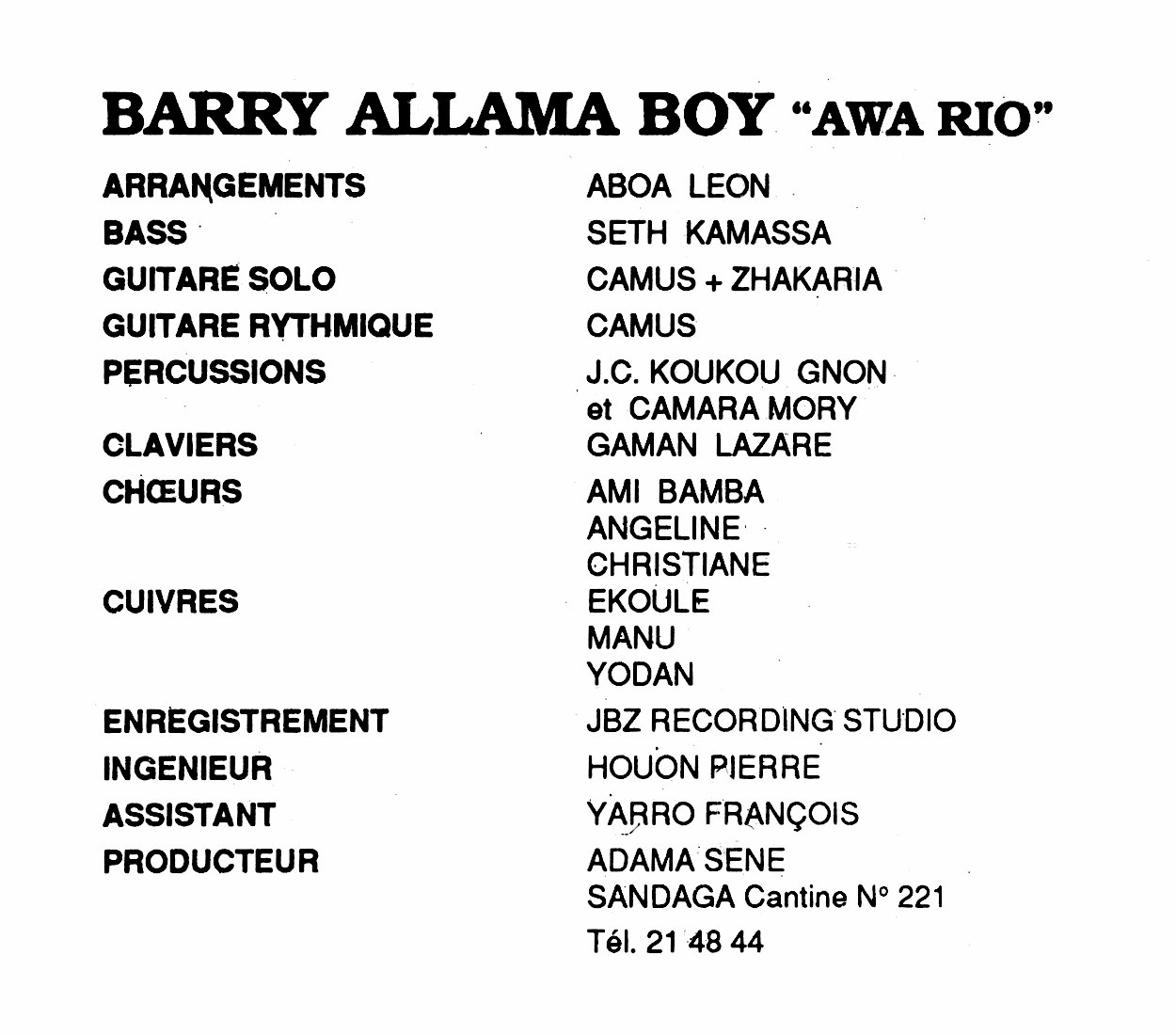
Barry Allama Boy is a musician about whom I've been able to find nothing, and I mean NOTHING, on the internet or anywhere else. This cassette, Medina Larabi, was recorded in Ivory Coast, but I believe he is from Senegal, probably from the southern Casamance region. I like this indigenous Senegalese take on reggae music and I hope you will too!


Download Medina Larabi as a zipped file here.


Friday, April 5, 2019

Music For Ramadan


I just realized that Ramadan this year begins the evening of May 5 and ends the evening of June 4. It's a little early, but I thought it would be nice if we could listen to some music from Nigeria that is intended for this auspicious occasion.

There are two terms for Yoruba Islamic music used to arouse the faithful during Ramadan: Ajísáàri and wéré. Ajísáàri refers either to the style of music or the person who performs it. Ajísáàri is usually performed solo and wéré by ensembles. Ajísáàri and wéré are performed by men. A related genre, wákà, is performed by women. These popular Islamic styles are percursors of secular fújì music, which is quite popular in Yorubaland. Christopher Alan Waterman discusses this music in his essential study Jùjú: A Social History and Ethnography of an African Popular Musc (University of Chicago Press, 1990):

Extensive Islamic conversion led to the development of musical genres performed during Muslim holidays (e.g., Ramadan, Id El-Fitr) and ceremonies marking the return of pilgrims from Mecca (àláji, m.; àlájà, f.). One of the earliest of these genres was wákà, sung by women and accompanied by beaten sélí or péréṣéké, pounded tin discs with metal rings attached. Another popular genre, wéré or ajísáàri, was performed by groups of young men during the Ramadan fast to wake the faithful for their early meal. Both of these genres incorporated aspects of Islamic cantillation — nasalized, tense vocal quality, melismatic text settings, microtonal melodic embellishments, and Qur'anic texts — into performances guided by Yoruba musical values and techniques. Wákà and wéré were associated with the high status of Islam in traditional Lagos and the continued vitality of economic networks linking the Yoruba to Muslim societies in the northern hinterland. 
Today's musical offereing, Itan Anabi Muhammad (Leader Records LRCLS 61, 1987), is one of a number recorded by the youth group of the Ansar-Ud-Deen Society of Lagos. The Society itself is a fraternal and educational association founded by Yoruba Muslim notables in 1923. It was a response to the ascendence of Christian elites and had a reformist conception of Islam which sought to reconcile it with modern ideas.

Ansar-Ud-Deen Youth (Lagos Branch) - Yatarikan Li Solathi / Itan Anabi Muhammad

Ansar-Ud-Deen Youth (Lagos Branch) - Alhamdu Lil'Lahi

Ansar-Ud-Deen Youth (Lagos Branch) - Latarkanana Ilal Ahwah / Eje Ka Ronu Eyin Araiye / Bi Al Ouyaoma Ba De

Download Itan Anabi Muhammad as a zipped file here.


Monday, March 25, 2019

Back to the Village


It's time for another deep dive into the world of "Igbo Blues"- real village music from southeastern Nigeria!

I know nothing about Goddy and Achinkwa and their musical group. This LP, Anya Ukwu Adiro Nma (Nigerphone NXLP 014, 1989), though, is one of the best examples of this genre I've heard, displaying the full panoply of traditional bells and percussion - ogene, onye ekwe, igba and the like. Enjoy!

Goddy na Achinkwa Musical Group - Uchicha Melu Ife Ebolu Oke

Goddy na Achinkwa Musical Group - Ezigbo Omume Akaka

Goddy na Achinkwa Musical Group - Anya Ukwu Adiro Nma

Goddy na Achinkwa Musical Group - Lagos Special (Ego Igwe)

Download Anya Ukwu Adiro Nma as a zipped file here.


Wednesday, March 20, 2019

A Purloined Master Tape


Back in the early days of online file-sharing, the 1973 album Destruction (Orbitone OT 005) by the Nigerian group the Nkengas achieved legendary status, traded far and wide and included on numerous funky mixes. When an official reissue came out in 2013 (Secret Stash Records SSR-CD-293), fans could satisfy their cravings legally.

The Nkengas released one other LP, Nkengas in London (Orbitone OT 006, 1973), which I feature here. It's apparent even from a casual listening that this is a radically different recording than Destruction. Every song save one ("Asa Mpete Special") features the vocals of the great highlife superstar Chief Stephen Osita Osadebe.

What's going on here? The story, as best I can piece it together, involves a number of sessions in London in the early '70s, which produced some of Osadebe's most beloved recordings. At some point in the process members of Osadebe's backup band, the Nigeria Sound Makers, led by Victor Okoroego, defected, taking a master tape with them and marketing it as Nkengas in London. Destruction, on the other hand, is pretty much pure Okoroego save for one track, "London Special," with Osadebe on lead vocals.

After Nkengas in London the group changed its name to the Ikenga Super Stars of Africa, who were to achieve fame and fortune with a number of chart-topping hits. "Asa Mpete Special" on Nkengas in London features Pele Asampete on vocals. This is a slightly reworked version of  the Osadebe hit "Ezi Ogelidi" from the album Egbunam (Philips 6361024, 1972). Asampete later left the Ikengas and did another version of this tune, "Ezi O Goli," on his solo LP (Rogers All Stars RASLPS 043). Pop/highlife star Chris Mba did still another remake in the early 1990s.


Download Nkengas in London as a zipped file here.


Friday, March 15, 2019

Ebenezer Obey Sings For The People


Singing For The People (Obey WAPS 578, 1980) continues the explorations in jùjú-funk that Ebenezer Obey started with Eyi Yato (Decca WAPS 508, 1980), posted a few days ago in this space. There's nothing much more I can say except if you liked that one, you'll like this one. Enjoy!

Chief Commander Ebenezer Obey & his Inter-Reformers Band - Singing For the People / Je K'Ajo Mi Jashi Rere

Chief Commander Ebenezer Obey & his Inter-Reformers Band - Alfa Omega / O Se Baba

Chief Commander Ebenezer Obey & his Inter-Reformers Band - Eiye To Ma Ba Kowe Ke / Mori Sisi Kan / Eje A Mo / Nike Oluwole

Download Singing For The People as a zipped file here.